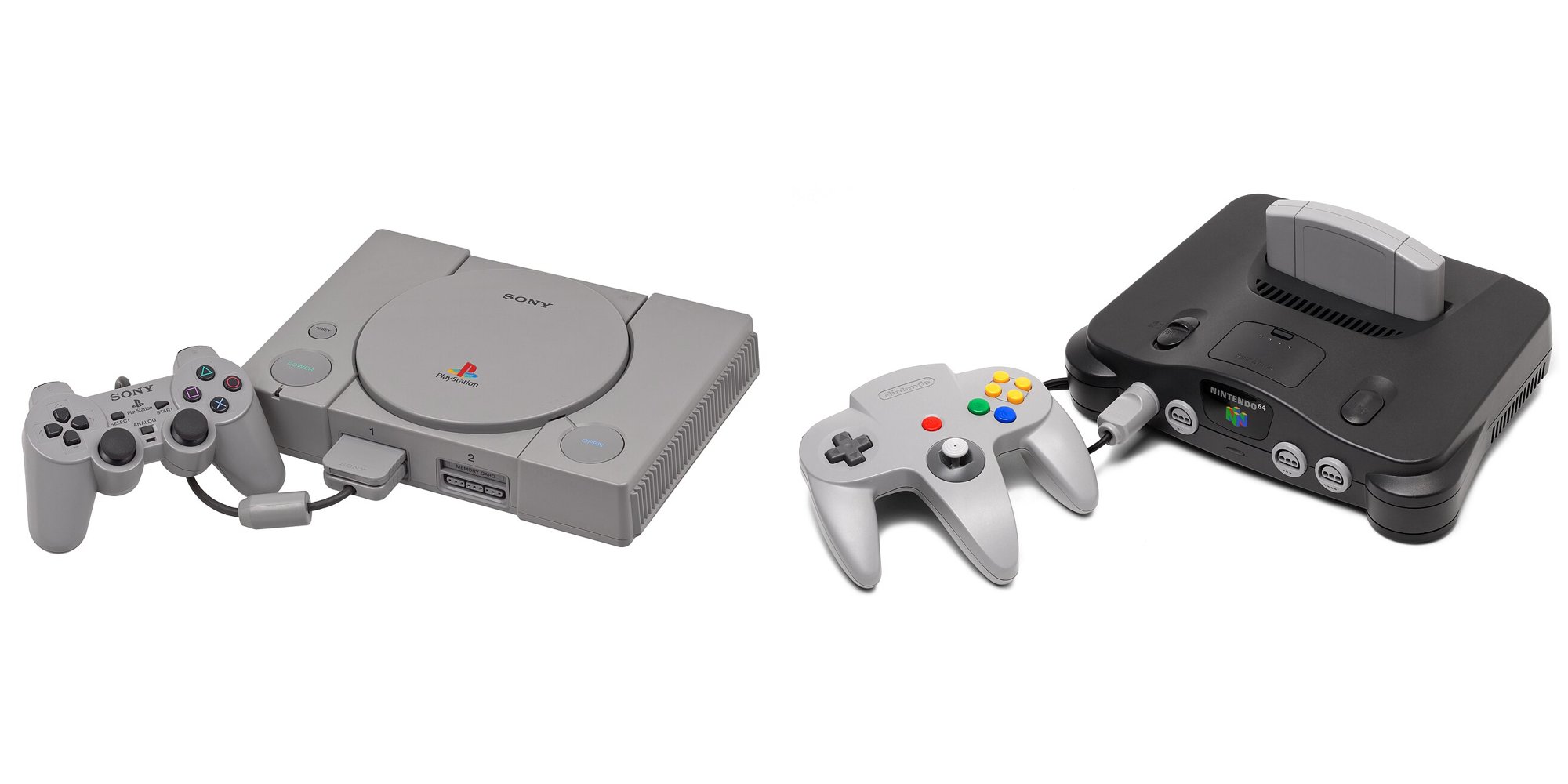
PS1 vs N64 was the playground argument of the late 90s. On one side sat Sony’s grey PlayStation, the newcomer with CDs, moody 3D and a cool image. On the other was the Nintendo 64, a chunky black box with cartridges, four controller ports and Super Mario 64. Nearly 30 years on, here’s how the fight really played out, why it ended the way it did, and which one deserves your shelf space today.
Quick facts
- Launched in the UK: PlayStation on 29 September 1995; Nintendo 64 on 1 March 1997, 18 months later.
- Price at launch (UK): £299 for the PlayStation, according to musicMagpie’s gaming timeline, and £249.99 for the N64, according to the Centre for Computing History.
- Sold worldwide: over 100 million PlayStations against 32.93 million N64s.
- Why it mattered: it was the battle that moved home gaming into 3D, and the first time Sony beat Nintendo.
| Product | Key spec | UK price at time of writing | Best for | Link |
|---|---|---|---|---|
| Sony PlayStation (PS1) | 32-bit R3000 CPU at about 33.9MHz, CD-ROM discs | Not sold new (launched at £299 in 1995) | Story-driven RPGs, racers and big third-party games | Retro consoles in our shop |
| Nintendo 64 (N64) | 64-bit NEC VR4300 CPU at 93.75MHz, cartridges | Not sold new (launched at £249.99 in 1997) | Four-player split-screen and Nintendo’s own classics | Retro consoles in our shop |
How Nintendo accidentally created its biggest rival
The twist is that the PlayStation began as a Nintendo project. Sony already made the sound chip for the Super Nintendo, and Nintendo hired it to build a CD-ROM add-on, nicknamed the “Play Station”. Then, at a 1991 trade show, Nintendo announced it was working with Philips instead, a move the PlayStation’s Wikipedia entry notes has been called “the greatest ever betrayal” in the industry. Sony’s Ken Kutaragi kept going, and the result was a console of Sony’s own.
Discs vs cartridges: the decision that settled it
The biggest difference wasn’t power. It was what the games came on. The PlayStation used CDs, which were cheap to press and held far more data, so developers could pack in full-motion video, CD-quality music and huge worlds. The N64 stuck with cartridges. As the N64’s Wikipedia entry puts it, cartridges gave faster load times and were tougher, but they cost more to make, held less and took longer to manufacture.
You felt that in the shops. N64 games were often pricier, and new releases came less often. In 1997 Nintendo announced a pricing change that worked out at roughly a 15% cut on games to help close the gap. The upside was real, though: N64 games loaded almost instantly, while PlayStation owners got used to loading screens and the odd scratched disc.
Final Fantasy VII and the third-party exodus
Storage cost Nintendo its most famous partners. Square and Enix had originally planned to release Final Fantasy VII and Dragon Warrior VII on the N64, but switched to Sony’s console because of storage limits. Final Fantasy VII went on to sell 9.72 million copies and became one of the games that defined the PlayStation, alongside Gran Turismo, Metal Gear Solid, Crash Bandicoot, Spyro, Tekken 3 and Tomb Raider. More than 4,000 PlayStation games were released in total, while 388 came out on the N64.
Where the N64 still won
If the PlayStation had more games, the N64 had many of the best ones. Super Mario 64 sold 11 million copies, making it the best-selling console game of the generation, just ahead of Gran Turismo on 10.85 million. GoldenEye 007 and The Legend of Zelda: Ocarina of Time still turn up on lists of the greatest games ever made.
It was built for friends on the sofa, too. Four controller ports came as standard, where PlayStation owners needed a multitap adapter for more than two players. It’s a big reason Mario Kart 64 and GoldenEye multiplayer are still so fondly remembered. The N64 also added the Rumble Pak for force feedback, and the Expansion Pak later doubled its memory from 4MB to 8MB. Sony answered with its DualShock controller, with twin analogue sticks and vibration, in November 1997.
What happened in Britain
The UK was firmly PlayStation country. Sony had an 18-month head start, and the day before the N64 launched here, The Independent reported that Sony was cutting the PlayStation from £199.99 to £129.99, while only 20,000 N64s had been shipped to the UK for launch day. The N64 arrived with just three games: Super Mario 64, Pilotwings 64 and Star Wars: Shadows of the Empire. Worldwide, Wikipedia notes the N64 was a major success in North America but underperformed in Japan and Europe.
Relive it today
Original consoles and games are easy to find second-hand, but prices for the most wanted games have climbed, and both machines were made for CRT TVs, so they can look soft and laggy on a modern flat screen without an upscaler. Check that any second-hand console comes with the right power supply and a working controller, and that N64 cartridges have clean contacts.
If you’d rather not hunt through car boot sales, both companies have kept their classics available on current consoles through their online subscription services, so check the PlayStation Store and Nintendo eShop for the games you remember. And if 8-bit home computers are more your era, we stock plug-and-play retro machines in our shop, including THEC64 and The Spectrum, or you can browse all our consoles.
Our verdict
On sales, the PS1 vs N64 war wasn’t close. Sony sold roughly three PlayStations for every N64, thanks to cheaper discs, a huge third-party library and a head start. But the N64 won plenty of hearts, with some of the most influential games ever made and the best four-player nights of the decade. If you were a teenager in Britain in the 90s, you probably had a PlayStation. If you had mates round, you probably wished you had an N64 as well. For more retro tech, read our Nokia 3310 history, ZX Spectrum vs Commodore 64 and Sony Walkman history, or find a present for a gamer in our best gaming gifts under £50 guide.
FAQ
Which sold more, the PS1 or the N64?
The PlayStation, by a long way. It became the first games console to ship over 100 million units, while Nintendo sold 32.93 million N64s.
When did the N64 come out in the UK?
The Nintendo 64 launched in the UK and the rest of Europe on 1 March 1997 at £249.99, about 18 months after the PlayStation arrived on 29 September 1995.
Why did the N64 use cartridges instead of CDs?
Cartridges loaded almost instantly and were hard to damage. The trade-off was cost and space: they were dearer to make and held far less, which pushed games like Final Fantasy VII to the PlayStation.
Featured image: Sony PlayStation and Nintendo 64. Photos by Evan-Amos, via Wikimedia Commons and Wikimedia Commons, public domain.