Eighteen years ago today, on 31 October 2008, a nine-page paper landed on a cryptography mailing list and quietly kicked off one of the strangest stories in modern tech. The history of Bitcoin runs from that paper to two pizzas, a string of crashes and hacks, a country that made it legal tender, and finally Wall Street. Here’s how it happened, year by year, with sources linked so you can check every step.
This article is for information only and isn’t financial advice. Crypto is high-risk and you could lose all the money you put in.
Bitcoin at a glance
- White paper: 31 October 2008, by the pseudonymous Satoshi Nakamoto
- Network launched: 3 January 2009, with the genesis block
- Supply cap: 21 million bitcoins, with new issuance halving roughly every four years
- Why it mattered: the first widely used digital money that works without a bank or company in the middle
Before Bitcoin: the ideas it was built on
Bitcoin didn’t appear from nowhere. Wikipedia’s history of Bitcoin traces its building blocks back through the 1990s: Adam Back’s hashcash, a 1997 proof-of-work scheme meant to fight spam; Wei Dai’s b-money and Nick Szabo’s bit gold, two early proposals for scarce digital money; and Hal Finney’s reusable proof of work. None of them took off as a currency. Satoshi Nakamoto’s trick was to stitch these existing ideas together into something that actually ran.
2008: the white paper
The domain bitcoin.org was registered on 18 August 2008. On 31 October, Nakamoto shared Bitcoin: A Peer-to-Peer Electronic Cash System. In plain terms, it described a way for people to send money directly to each other online, with a shared public record (the blockchain) kept honest by computers competing to add new blocks, rather than by a bank. The paper’s own phrase was “a system for electronic transactions without relying on trust”.
Nobody knows for sure who Satoshi Nakamoto is. The name is widely presumed to be a pseudonym for one person or a group, and Nakamoto later stepped away, handing the reins to developer Gavin Andresen.
2009: a British headline in the first block
The network went live on 3 January 2009, when Nakamoto mined the first block, known as the genesis block, with a reward of 50 bitcoins. Hidden inside it was a line of text with a very British flavour: “The Times 03/Jan/2009 Chancellor on brink of second bailout for banks.” It was a real front-page headline from The Times that day about Alistair Darling and the banking crisis. It works as a timestamp, and many read it as a pointed comment on the banking system Bitcoin was trying to work around.
Days later, on 12 January 2009, Hal Finney received 10 bitcoins from Nakamoto in the first Bitcoin transaction. There’s a Welsh footnote too: one early miner, James Howells, lost thousands of bitcoins on a hard drive that ended up in a landfill in Newport, according to the same Wikipedia history.
2010 to 2011: pizza and the first dollar
For its first year, a bitcoin was worth basically nothing. That changed on 22 May 2010, when Florida programmer Laszlo Hanyecz offered 10,000 bitcoins for two pizzas on the Bitcointalk forum, and someone took him up on it. It’s remembered as the first notable purchase of physical goods with Bitcoin, and fans still mark 22 May as Bitcoin Pizza Day. By early 2011, a bitcoin had reached parity with the US dollar.
2013 to 2017: hype, hacks and the first big bubble
Bitcoin’s early boom years were also its most chaotic. Prices swung wildly in 2013, and in early 2014 Mt. Gox, then one of the biggest exchanges, suspended withdrawals and filed for bankruptcy in Japan amid reports that 744,000 bitcoins had been stolen. It set a pattern that’s repeated ever since: the coins themselves keep working, but the companies holding them for people can fail. Our look at the Binance hack and what it means for UK users covers the modern version of that risk.
In 2017 came the first mainstream mania. Bitcoin passed $1,000 again early in the year and reached about $19,783 on 17 December 2017, before losing a third of its value within days. The same year, an argument over how big blocks should be ended in a split on 1 August 2017, creating Bitcoin Cash as a separate coin.
2020 to 2023: companies, a country and a crash
The 2020s brought bigger players. Firms such as MicroStrategy and Tesla bought bitcoin in early 2021, and the price hit new highs that year. In June 2021, El Salvador passed a law making Bitcoin legal tender alongside the US dollar, the first country to do so.
That experiment was later scaled back. In January 2025, as part of a $1.4 billion loan deal with the International Monetary Fund, Reuters reported that El Salvador’s Congress made accepting bitcoin voluntary for businesses. The IMF’s own report adds that taxes are now paid only in US dollars. In between, 2022 was brutal: the collapse of the Terra-Luna project helped push bitcoin below $18,000 in June 2022, under its 2017 peak.
2024 to 2025: Wall Street arrives
The biggest shift came on 10 January 2024, when the US Securities and Exchange Commission approved the listing of spot bitcoin exchange-traded products, funds that hold real bitcoin and trade like shares. The SEC chair’s statement was notably cool about it, saying the agency “did not approve or endorse bitcoin” and calling it “primarily a speculative, volatile asset”.
In April 2024 the fourth halving cut the reward for each new block from 6.25 to 3.125 bitcoins. Halvings are built into the code and keep slowing new supply until the 21 million cap is reached. The price passed $100,000 for the first time on 5 December 2024, and Wikipedia’s price timeline records a new high of about $126,000 on 6 October 2025. All of these figures are US dollar prices, not UK ones.
What about the UK?
The UK has moved more slowly. In January 2021 the Financial Conduct Authority banned the sale of crypto derivatives and crypto exchange-traded notes (ETNs) to ordinary investors. From 8 October 2025, the FCA lifted the ban on retail access to crypto ETNs listed on a UK recognised exchange, while keeping the ban on crypto derivatives. The FCA also points out that these products aren’t covered by the Financial Services Compensation Scheme (FSCS).
The case for and against Bitcoin
This section is opinion, not fact or advice. Supporters argue that 17 years of the network running without a central operator, a fixed supply and growing acceptance by big institutions show Bitcoin has earned a place as a kind of digital gold. Critics point to the same history and see something else: huge price swings, repeated exchange failures, links to crime that the SEC itself highlighted, and El Salvador’s retreat as evidence that it hasn’t worked as everyday money. Both readings fit the facts, which is why it’s worth being sceptical of anyone who’s certain either way.
Verdict: what the history tells us
The history of Bitcoin is a story of an idea that kept surviving its own disasters. It started as a mailing-list experiment, became a speculative asset, and is now held by funds on Wall Street. What hasn’t changed is the volatility. If you’re curious about crypto, learn how it works and where the risks sit before anything else. For more tech history, see our Nokia 3310 history and ZX Spectrum vs Commodore 64 pieces.
FAQ
When was Bitcoin created?
Satoshi Nakamoto published the Bitcoin white paper on 31 October 2008, and the network launched on 3 January 2009 with the genesis block.
Who invented Bitcoin?
A person or group using the name Satoshi Nakamoto. Their real identity has never been confirmed.
What was the first thing bought with Bitcoin?
The first notable purchase of physical goods was two pizzas, bought for 10,000 bitcoins on 22 May 2010.
How many bitcoins will there ever be?
The supply is capped at 21 million, with new issuance halving roughly every four years.
Can UK investors buy Bitcoin funds?
Since 8 October 2025 the FCA has allowed ordinary investors to buy crypto ETNs listed on a UK recognised exchange. They aren’t covered by the FSCS, and this isn’t financial advice.
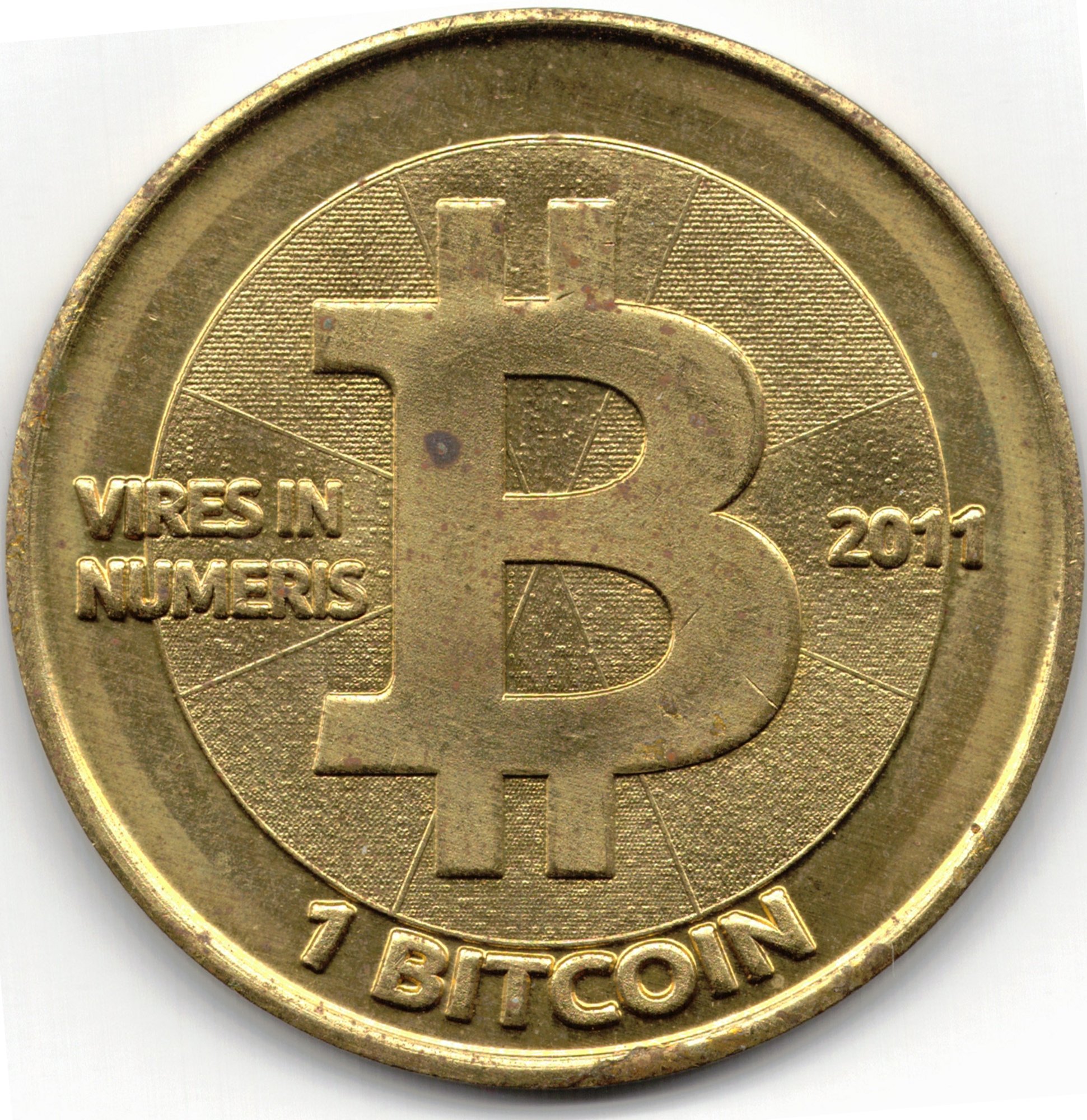
Featured image: Physical 2011 Casascius 1 Bitcoin token, photo by Tiberiandusk via Wikimedia Commons, CC BY-SA 4.0.