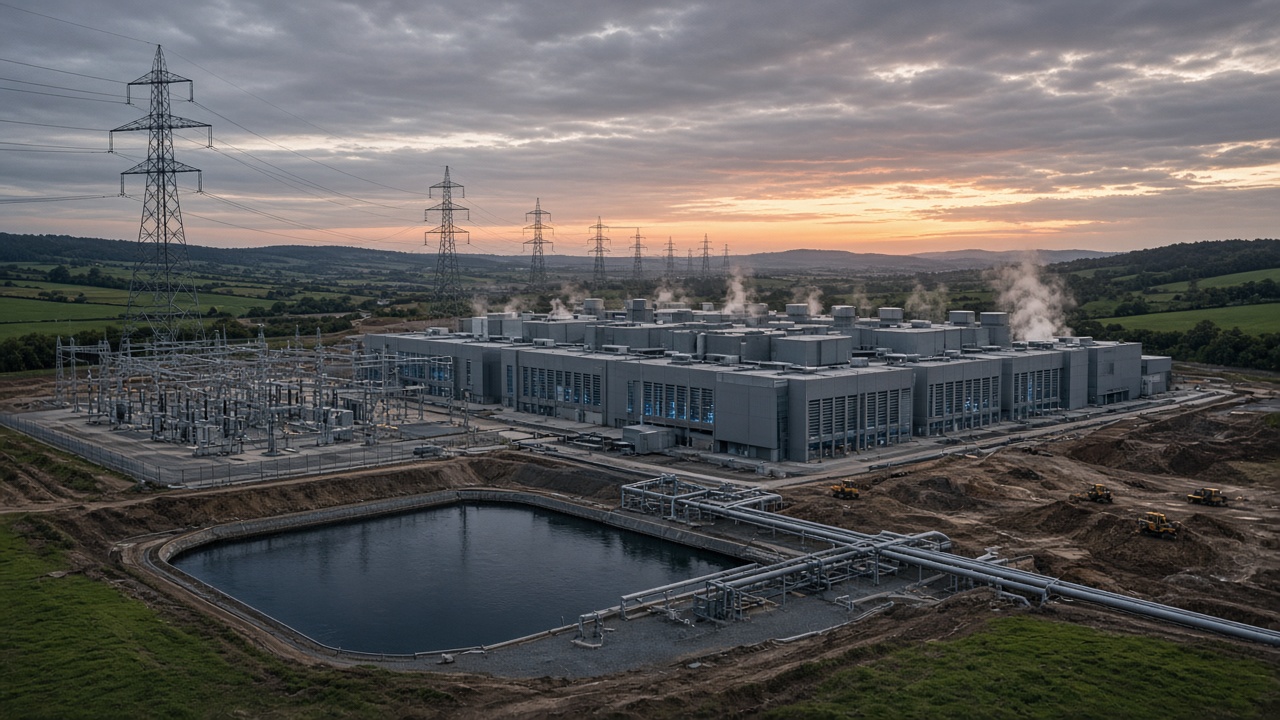
Artificial intelligence is moving at a frightening lick. Every day there’s a new tool promising to make life easier, knock out a stunning picture or write a page of copy in seconds. But there’s another side to all this that doesn’t get talked about nearly enough, and I think it’s time we did.

Behind every AI picture is a building full of computers
Every AI-generated image, cartoon or video comes out of a data centre: rows of powerful computers that need enormous amounts of electricity, and often water to keep them cool. Building and expanding them takes land, materials and other natural resources too. None of that shows up on your screen when the picture pops out.
The scale is already big. The International Energy Agency’s Energy and AI report says data centres used around 415 terawatt-hours (TWh) of electricity in 2024, about 1.5% of the world’s electricity consumption. It expects that to more than double to around 945 TWh by 2030, which is slightly more than Japan uses today, and it names AI as the most important driver of that growth.
Not every AI job costs the same
Here’s the bit that surprised me. Researchers at Hugging Face and Carnegie Mellon measured the energy used by different AI tasks in their study Power Hungry Processing (Luccioni and colleagues, 2023). Image generation came out as the most energy-hungry task they tested, averaging 2.9 kWh per 1,000 images. That’s over 60 times the average for text generation (0.047 kWh per 1,000 responses). The least efficient image model they tested used 11.49 kWh per 1,000 images, which the authors put at around half a smartphone charge for every single picture.
What it took to make this image (a rough estimate)
The honest answer: we don’t know the exact figure for the picture at the top of this page. The company behind the tool we used doesn’t publish per-image energy or water numbers.
Energy: in the Power Hungry Processing tests, generating an image used about 2.9 watt-hours on average (2.9 kWh per 1,000 images), and up to about 11.5 Wh for the least efficient model. The researchers say figures vary a lot between models and image sizes, and they tested open models, not today’s commercial tools. Taking their figure of 0.022 kWh (22 Wh) to charge an average smartphone, the average image is roughly 2.9 ÷ 22 ≈ 13% of a phone charge, and the hungriest model about half a charge.
Water: the UC Riverside study says data centres evaporate roughly 1 to 9 litres of water per kWh of server energy on site, plus about 3.1 litres per kWh used off site to generate US electricity on average. At 2.9 Wh per image, that works out at roughly 0.0029 × (1 + 3.1) ≈ 12ml up to 0.0029 × (9 + 3.1) ≈ 35ml of water. That’s a very rough estimate, not a measurement.
One picture is a drop in the ocean. Millions of them a day is not.
The thirst nobody mentions
Water is the part that bothers me most. The “Making AI Less Thirsty” paper from the University of California, Riverside (Li, Ren and colleagues) estimates that GPT-3 needs to “drink” a 500ml bottle of water for roughly every 10 to 50 medium-length responses, depending on when and where it runs. Looking ahead, it projects that global AI demand could account for 4.2 to 6.6 billion cubic metres of water withdrawal in 2027. By the paper’s own comparison, that’s more than half the UK’s total annual water withdrawal.
The big firms’ own figures point the same way. Google’s 2024 Environmental Report says its data centres consumed 6.1 billion gallons of water in 2023, 17% more than the year before, and it links the rise to AI. Clean water isn’t infinite, and in a dry summer it’s not something we can treat as free.
More data centres, more emissions
As demand for AI grows, so does the pressure on the infrastructure behind it. More data centres mean more demand for electricity, and where that power comes from fossil fuels, more pollution and greenhouse gas emissions. Google’s report says its total emissions were 48% higher in 2023 than in 2019, mainly because of data centre energy use and its supply chain. Microsoft says its emissions were up 29.1% on its 2020 baseline, mostly from building more data centres. These are companies with serious climate targets, and they’re still going the wrong way.
Closer to home
This isn’t just an American problem. The UK government has designated data centres as Critical National Infrastructure, putting them alongside energy and water systems, and it’s actively courting new ones. I’m not against that. But if we’re going to welcome these sites, we should be just as keen to ask where their power and water are coming from. If you want the wider industry picture, we’ve written about how AI data centres are squeezing the world’s memory supply as well.
Are we thinking enough about it?
AI can be genuinely useful. It can support medical research, help crack complex problems and make some tasks easier. But not every use has the same value. There’s a real difference between using this technology to solve meaningful problems and churning out endless streams of throwaway digital content just because we can.
Our planet has limited resources. Clean water, healthy ecosystems and a stable climate matter far more than the latest online trend.
Conclusion: we need sustainable AI
This is my opinion. Progress should make life better, not leave us with a bigger environmental bill. So let’s ask the awkward questions. How can AI be made more efficient? Where does its energy come from? Are its growing demands for power and water being managed responsibly? And let’s ask the companies to publish proper per-task figures, so none of us has to guess what a picture really costs. Technology should serve people and the natural world, not come at their expense.
FAQ
How much electricity do data centres use?
The International Energy Agency estimates data centres used around 415 TWh in 2024, about 1.5% of global electricity consumption, and expects this to more than double to around 945 TWh by 2030, with AI the main driver.
How much energy does it take to generate one AI image?
In the Power Hungry Processing study, image generation averaged 2.9 kWh per 1,000 images, about 2.9 Wh each, with the least efficient model using about 11.5 Wh. Real figures for commercial tools are not published and vary by model and image size.
Does AI use water?
Yes. Many data centres use water for cooling, and power stations use water to generate electricity. UC Riverside researchers estimate GPT-3 consumes a 500ml bottle of water for roughly every 10 to 50 medium-length responses.
Can AI be made more sustainable?
It can be made more efficient by choosing smaller models where they will do, running data centres on clean power, cutting cooling water use and publishing honest per-task energy and water figures.