As an Amazon Associate, TrueNorth Tech X earns from qualifying purchases. Read our affiliate disclosure.
The Sony Walkman history starts with a simple, slightly selfish wish. Sony co-founder Masaru Ibuka wanted to listen to music in stereo on long flights, and the company’s portable recorders were too heavy to lug around. What his engineers built for him went on sale in Japan on 1 July 1979 as the Walkman TPS-L2. Within a few years, wearing headphones in the street had gone from odd to normal, and “Walkman” had become the word for any personal stereo.
Quick answer
- Launched: 1 July 1979 in Japan, as the TPS-L2, for ¥33,000.
- UK name at first: the Stowaway. It was the Soundabout in the US and the Freestyle in Sweden and Australia.
- Sales: about 220 million cassette Walkmans worldwide by 2010, when Sony stopped making them for Japan.
- Relive it today: a new cassette player such as the FiiO CP13 plays your old tapes with USB-C charging.
Where the Walkman came from
Sony didn’t invent the cassette, and it didn’t invent the headphone. What it did was take things it already made and strip them down. According to Sony’s own history, Ibuka had a mono tape recorder converted into a stereo player for his travels. When fellow founder Akio Morita tried it, he said: “This is interesting! It would satisfy the wishes of young people who want to enjoy music all day long.”
The base was the Pressman, a small cassette recorder Sony sold to journalists. The engineers took out the recording parts and the speaker, kept the playback mechanism, and paired it with very light headphones. Plenty of people inside and outside the company thought a tape machine that couldn’t record would never sell. Morita pushed it through anyway.
Two headphone sockets and a “hotline” button
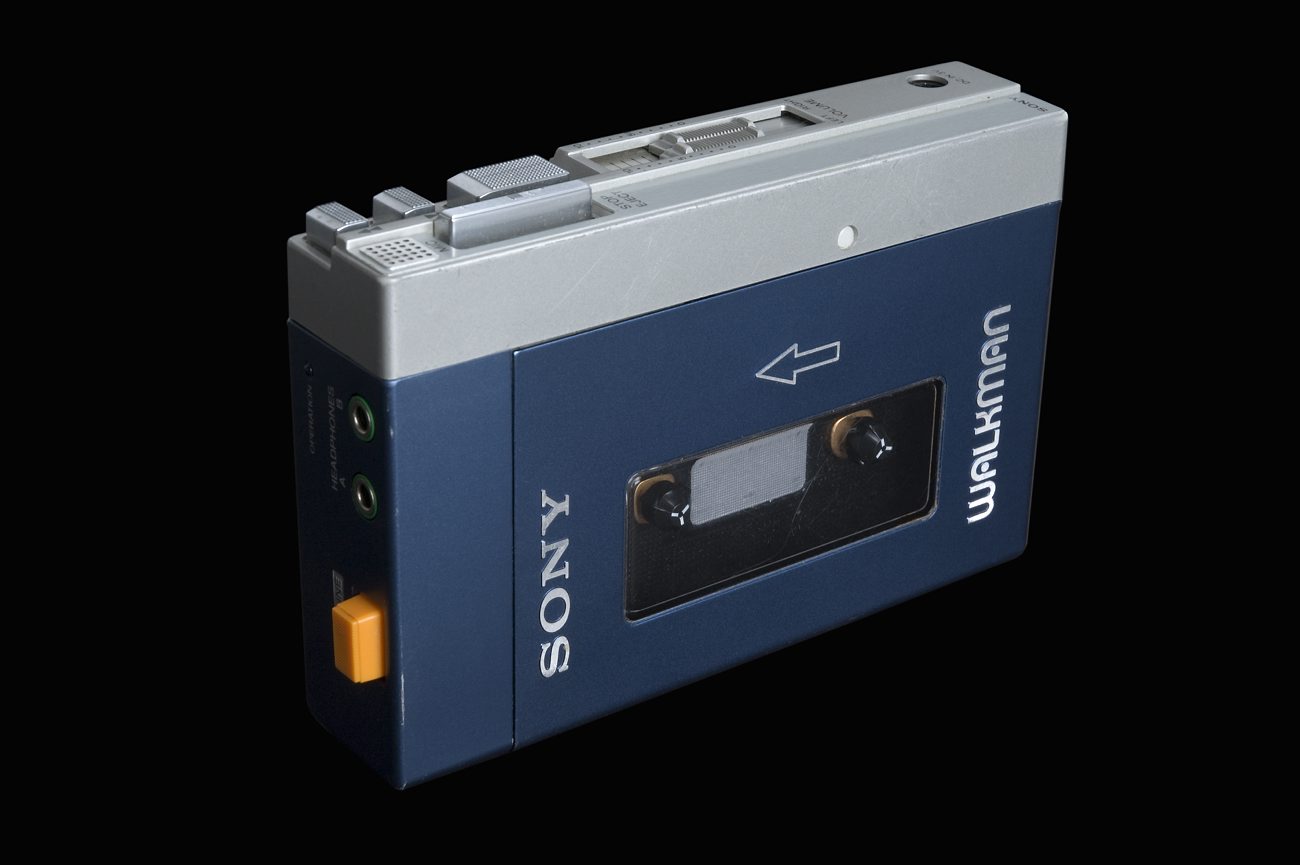
The first Walkman was a chunky blue-and-silver metal box weighing about 390g. It had a quirk that tells you how new the idea of private listening was. Morita worried it would seem rude to shut yourself off with headphones, so the TPS-L2 had two headphone sockets and an orange HOT LINE button. Press it and a built-in microphone let you talk to whoever was sharing your music, without either of you taking your headphones off.
It turned out people didn’t want to share. As the Smithsonian notes, buyers soon saw the Walkman as something very personal, and by around 1983 the hotline had gone and the two sockets had become one.
Stowaway, Soundabout and Freestyle
Sony’s overseas offices didn’t like the name. “Walkman” was made-up English, so the first model was sold as the Soundabout in the US, the Freestyle in Sweden and Australia, and the Stowaway in the UK. Sony America had even suggested “Sony Disco Jogger”, which Morita vetoed. Then travellers started bringing Walkmans home from Japan, and shoppers abroad began asking for it by name. Sony says Morita declared at a US sales meeting in April 1980 that Walkman would be the name everywhere. It reached the Oxford English Dictionary in 1986.
Britain has its own piece of the story on display. The V&A holds a Stowaway TPS-L2 with its MDR-3L2 headphones, given by Sony UK. Accounts of the UK launch price vary, but most put it somewhere between £100 and £120, which was a lot of money for a tape player at the time.
How the Walkman changed the way we listen
Before the Walkman, music on the move meant a radio or a shoulder-straining boombox that everyone around you had to hear too. The Walkman made music private and portable at the same time. You chose the soundtrack to your bus ride, your paper round or your walk to school, and nobody else had a say.
- The mixtape became an art form. Recording songs off the radio and lining up tracks for a friend, or a crush, was how a lot of us shared music.
- Headphones went public. Wearing them in the street went from strange to completely ordinary.
- Every rival copied it. Within a couple of years most big electronics brands sold their own personal stereo, but people still called them all Walkmans.
- It set up everything that came next. The Discman, the MiniDisc player, the iPod and the phone in your pocket all follow the idea Sony proved in 1979.
The numbers back that up. When Sony stopped making cassette Walkmans for Japan in 2010, it said it had sold about 220 million cassette Walkmans worldwide since 1979. Counting CD, MiniDisc and digital models too, the Walkman family had passed roughly 400 million by March 2010. Sony still uses the Walkman name on its digital music players today.
Tapes are back, sort of
Cassettes never fully went away, and they’re having a small moment again. The Official Charts Company says UK cassette sales rose 53% in 2025 to about 164,000. That’s tiny next to vinyl, but artists now release tapes as collectables, and Robbie Williams’ Better Man soundtrack sold 21,400 cassettes on its own. So if you’ve got a shoebox of old tapes in the loft, now’s a good time to dig it out.
Relive it today
Prices change often. Tap Check price on Amazon for today’s price.
An original TPS-L2 is a collector’s item now, and decades-old rubber belts don’t always survive. If you just want to hear your tapes again, a new player is the easier route. The FiiO CP13 is one of the best-known modern portable cassette players. It has a fully analogue audio path, an aluminium body, a 3.5mm headphone socket and a rechargeable battery that FiiO rates at over 13 hours, charged over USB-C.
Worth knowing: it plays tapes but doesn’t record them, there’s no Bluetooth, and it has no Dolby noise reduction, so tapes recorded with Dolby B can sound a little bright and hissy. Pair it with a decent pair of wired headphones.
FAQ
When did the Sony Walkman come out?
The first Walkman, the TPS-L2, went on sale in Japan on 1 July 1979. It reached the US in June 1980 and was first sold in the UK as the Stowaway.
Does Sony still make cassette Walkmans?
No. Sony stopped making cassette Walkmans for Japan in 2010 and the line has since ended. The Walkman name lives on in Sony’s digital music players.
Why did the first Walkman have two headphone sockets?
Akio Morita thought listening alone might seem rude, so the TPS-L2 let two people listen at once and talk through a built-in microphone using the HOT LINE button. Later models dropped both features.
Our verdict
The Walkman wasn’t the most advanced machine Sony ever made. It was a tape recorder with bits taken out. But it changed how a whole generation listened, turned the mixtape into a love letter and paved the way for every music player since. If you want that feeling back, find your old tapes and give them a spin. For more listening kit, see our best Xbox headset under £100 guide, or check today’s deals.
Featured image: Sony Walkman TPS-L2. Photo by Anna Gerdén, Tekniska museet, via Wikimedia Commons, licensed CC BY-SA 3.0.