As an Amazon Associate, TrueNorth Tech X earns from qualifying purchases. Read our affiliate disclosure.
For years Apple told us touchscreen laptops were a daft idea. Now it’s gone and made one. The new touchscreen MacBook Pro, officially the MacBook Pro with PROLED XDR Display, starts at £2,899 in the UK, and the first hands-on verdicts are in. The screen gets proper praise. The touch, not so much.
So is it worth it over the standard MacBook Pro, from £1,999 with Apple’s M6 chip? We haven’t tested one, so this is a researched verdict built on Apple’s UK press release, Apple’s UK store and early hands-on reports from The Verge and Marques Brownlee. As my granddad in Halifax used to say, there’s nowt wrong with a shiny new thing, as long as you’re not paying extra for the shine.
Quick answer
- Buy the touchscreen model if: you edit photos or HDR video, need Adobe RGB colour, or want the lightest MacBook Pro going, and the extra cost won’t sting.
- Buy the £1,999 M6 MacBook Pro if: you want a Pro laptop for everyday work and only fancy touch as a novelty.
- Don’t buy it for the touch alone: early hands-ons describe a screen that wobbles when tapped and no Apple Pencil support.
- Key dates: UK pre-orders opened on 28 October, and deliveries start on Friday 6 November.
What Apple actually announced
Apple unveiled the MacBook Pro with PROLED XDR Display on 28 October, in 14-inch and 16-inch sizes. The headline features, all from Apple’s own announcement:
- A tandem OLED screen with up to 2,000 nits peak HDR and SDR brightness, a 10,000,000:1 contrast ratio, a 120Hz variable refresh rate, and both P3 and Adobe RGB colour.
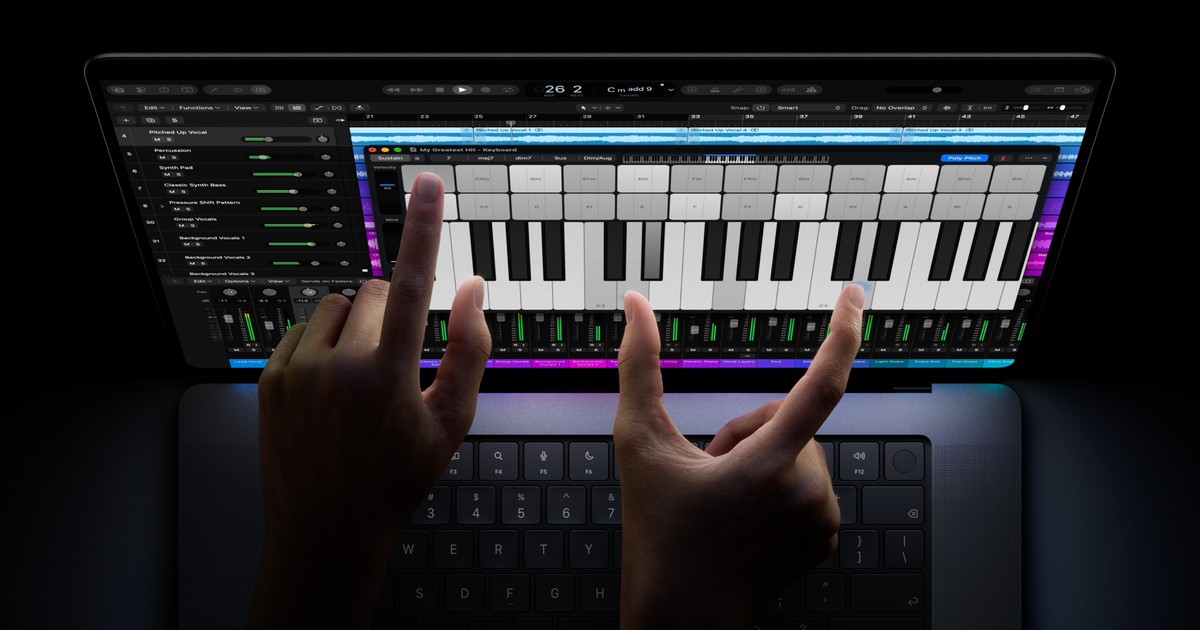
- Touch for the first time on a Mac, with the touch sensor built into the display panel rather than layered on top.
- The Dynamic Island replaces the notch, and it’s home to Spotlight, Live Activities and Siri AI.
- M5 Pro or M5 Max chips.
- A lighter body: Apple says the 14-inch weighs 3 pounds and the 16-inch 4 pounds. On Apple’s UK site that’s from 1.38kg for the 14-inch, against 1.60kg for the standard 14-inch M5 Pro.
UK prices: what touch costs you
Apple’s UK starting prices for the touchscreen model:
| Model | Chip | UK starting price |
|---|---|---|
| 14-inch PROLED XDR | M5 Pro | £2,899 |
| 16-inch PROLED XDR | M5 Pro | £3,399 |
| 14-inch PROLED XDR | M5 Max | £4,499 |
| 16-inch PROLED XDR | M5 Max | £4,799 |
| 14-inch MacBook Pro (no touch) | M6 | £1,999 |
Prices from Apple’s UK press release and Apple’s UK store on 30 October. Education pricing knocks £150 to £300 off the touch models.
Here’s the bit worth chewing on. The gap from the £1,999 M6 model to the £2,899 touch model is £900, but that £900 doesn’t all go on touch. The cheapest touch model also has the beefier M5 Pro chip. Like for like, the premium looks smaller. The Verge puts the touch OLED model at $400 more than the otherwise similarly specced M5 Pro MacBook Pro, but that’s a US price difference. Apple UK still sells a non-touch 14-inch M5 Pro MacBook Pro, but its UK newsroom and store pages don’t list that model’s price, so the UK gap isn’t confirmed by Apple. What is clear is that part of that £900 buys the M5 Pro chip, not just the OLED screen, touch and lighter body.
The hands-on verdicts: lovely screen, wobbly touch
Marques Brownlee (MKBHD) wasn’t sold on the touch after trying it. According to Dexerto’s write-up of his first-impressions video, he said: “It’s still kind of sloppy and messy to use it.” He noted that the display still wobbles when pressed, despite Apple’s stiffer hinge, and that there’s no Apple Pencil support. He’s no fan of touchscreen laptops generally, saying he never wants to “hold my arm out and have my arm get tired”.
The Verge saw the same wobble. Its hands-on says that “you can make it wobble pretty easily with some firm taps toward the top of the screen”, and called the lack of Pencil support “a huge missed opportunity”. Both were much keener on the screen itself. The Verge called it “gorgeous”, and Brownlee was impressed by the OLED and the weight drop, saying: “I’d upgrade for the weight savings before I would for the touchscreen.”
One more catch: Apple says the third-party apps it lists for touch support, such as Lightroom, DaVinci Resolve and Blender, will arrive later this year. Until then, macOS simply treats a tap as a click, which The Verge found fiddly on tiny Mac buttons.
Who should pay for touch and OLED?
The case for the touch model rests mostly on the screen, not the touch. If you grade HDR video, edit photos for print in Adobe RGB, or need a properly calibrated display away from your desk, PROLED XDR is a genuine tool. Anyone lugging a 16-inch about every day will feel the weight saving too.
Musicians and iPhone app developers get the most from touch itself. Apple shows off playing software instruments on screen in Logic Pro and testing iOS apps directly on the display. If that’s your job, the premium could earn its keep.
Who should buy the £1,999 M6 MacBook Pro instead?
Pretty much everyone else. The M6 model is the newer chip, it still has a mini-LED Liquid Retina XDR screen with up to 1,600 nits peak HDR brightness, and Apple says it lasts up to 24 hours on battery, like the touch model. If you write, code, browse and edit the odd video, it’s the sensible Pro. And if you don’t need a Pro at all, the MacBook Air with M5 does the everyday stuff for a good deal less.
Whichever Mac you pick, a fast external drive makes a big difference. Our best portable SSD guide has the picks, and our shop stocks the Samsung T9 Portable SSD. For a desk setup, the Twelve South Curve and Roost V3 laptop stand raise the screen to eye level, and the Belkin BoostCharge 100W USB-C GaN charger is a spare USB-C plug for your bag. Our desk gadgets round-up covers the rest.
Verdict: is touch worth £2,899?
For touch alone, no. On early evidence it’s a wobbly extra, not a reason to buy. The real draw is the tandem OLED screen and the lighter body, and those are worth the premium over a standard M5 Pro model (about $400 in the US, per The Verge) only if you’ll actually use the colour and brightness, or you carry your laptop everywhere. For most people, the £1,999 M6 MacBook Pro is the smarter buy. Wait for full reviews, and check what Black Friday 2026 might bring, before spending this kind of brass. For Apple’s AI push, see our look at its AI assistant in Pages, Keynote and Numbers.
FAQ
How much is the touchscreen MacBook Pro in the UK?
It starts at £2,899 for the 14-inch model with M5 Pro. The 16-inch M5 Pro is £3,399, and the M5 Max versions are £4,499 (14-inch) and £4,799 (16-inch).
Does the touchscreen MacBook Pro work with Apple Pencil?
No. Both The Verge and Marques Brownlee noted the lack of Apple Pencil support.
Is the touchscreen MacBook Pro faster than the M6 MacBook Pro?
It uses M5 Pro and M5 Max chips, which are aimed at heavier pro work than the base M6.
Featured image: MacBook Pro with PROLED XDR Display, official Apple press image from Apple Newsroom. Image: Apple.