As an Amazon Associate, TrueNorth Tech X earns from qualifying purchases. Read our affiliate disclosure.
Weighing up the RX 9060 XT vs RX 9070 XT in the UK? They’re AMD’s two most popular RDNA 4 graphics cards, and both come with 16GB of memory, so on paper they can look closer than they are. In practice the RX 9070 XT is a much bigger, faster and hungrier card. The right choice comes down to your monitor, your power supply and how much you want to spend on the whole upgrade, not just the card.
We haven’t tested these cards ourselves. This comparison is based on AMD’s and Sapphire’s official specifications and Tom’s Hardware’s published benchmark results, and we’ve linked the sources so you can check them.
Prices change often. Tap Check price on Amazon for today’s price. Graphics card prices have swung a lot this year, so compare the live prices before you decide.
Quick answer
- Gaming at 1080p, or 1440p on a budget: Sapphire PURE RX 9060 XT 16GB. It needs just one 8-pin plug and a 450W power supply.
- High-refresh 1440p or 4K with upscaling: Sapphire PULSE RX 9070 XT 16GB. It’s roughly three-quarters faster at 1440p, but AMD says you need a 750W power supply.
- Need a new PSU for the 9070 XT? The Corsair RM750e (white) or the Corsair RM850e.
RX 9060 XT vs RX 9070 XT: the specs side by side
| RX 9060 XT 16GB | RX 9070 XT | |
|---|---|---|
| Compute units | 32 | 64 |
| Stream processors | 2,048 | 4,096 |
| Memory | 16GB GDDR6, 128-bit | 16GB GDDR6, 256-bit |
| Memory bandwidth | Up to 320GB/s | Up to 640GB/s |
| Infinity Cache | 32MB | 64MB |
| Typical board power | 160W | 304W |
| Minimum PSU (AMD) | 450W | 750W |
| Power connectors | 1 x 8-pin | 2 x 8-pin |
Specs from AMD’s official RX 9060 XT and RX 9070 XT pages. Partner cards vary slightly: Sapphire rates its factory-overclocked PURE RX 9060 XT at 170W.
The short version: the RX 9070 XT has double the compute units, double the memory bus and double the bandwidth. The matching 16GB of memory is the only headline number the two share, and that’s why the 9060 XT can look like a bargain version of the same thing. It isn’t. It’s a different class of card.
How much faster is the RX 9070 XT?
Tom’s Hardware’s best graphics cards round-up (updated October 2026) averages 19 games at native resolution, with no upscaling or frame generation. Its figures give a clear picture of the gap:
- 1080p: 116.7fps for the RX 9070 XT vs 70.9fps for the RX 9060 XT 16GB, about 65% faster.
- 1440p: 85.3fps vs 48.6fps, about 75% faster.
- 4K: 47.4fps vs 24.5fps, nearly double.
Those are tough, maxed-out test settings, so you’ll see higher frame rates in lighter games such as Fortnite or Counter-Strike 2. What matters is the gap, and it grows as the resolution goes up. At 1080p the 9060 XT is a capable card. At 1440p in demanding games you’ll be turning settings down or leaning on upscaling. At 4K it’s out of its depth, while the 9070 XT can manage with some help from FSR.
Sapphire PURE RX 9060 XT 16GB: the sensible 1080p card
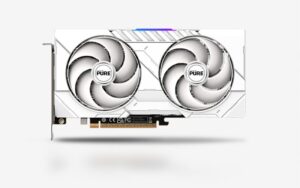
The Sapphire PURE RX 9060 XT Gaming OC is the easy upgrade. It’s a compact 2.3-slot, 240mm card, it takes one 8-pin power cable, and Sapphire says a 450W power supply will do. That makes it a straight swap in a lot of older or prebuilt PCs where a bigger card simply wouldn’t fit or couldn’t be powered. It’s all-white, too, if you’re building a white system.
The 16GB of memory is the big plus at this level. It gives you headroom for high-resolution textures in newer games that 8GB cards can struggle with. Just don’t mistake it for 1440p muscle: the narrower 128-bit bus and half the compute units are what hold it back.
The catch: if you already own a 1440p high-refresh monitor, you’ll likely want more speed within a year or two.
Sapphire PULSE RX 9070 XT 16GB: the 1440p powerhouse
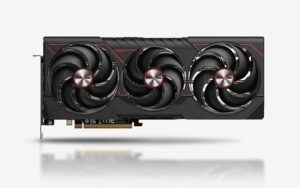
The Sapphire PULSE RX 9070 XT is Sapphire’s no-frills take on AMD’s top RDNA 4 chip. It’s a big card: three fans, three slots thick and 320mm long, so measure your case before you buy. Sapphire lists it at 304W typical board power with two 8-pin connectors and a minimum 750W power supply.
In return you get a card that’s built for high-refresh 1440p and can stretch to 4K with upscaling. Tom’s Hardware rates it as AMD’s most well-rounded card in years, though it also points out that Nvidia’s DLSS upscaling is supported in more games than AMD’s FSR 4.
The catch: the card is only part of the cost. If your current power supply is under 750W, budget for a new one too.
Power supply: the hidden cost of the RX 9070 XT
This is where a lot of upgrades come unstuck. The RX 9060 XT is happy on a decent 450W unit. The RX 9070 XT needs nearly twice the power, and AMD and Sapphire both say 750W minimum. If you’re upgrading an older PC, check the label on your PSU and that it has two separate 8-pin PCIe cables before you order.
If you need a new one, Corsair’s 2025 RMe range is a good fit. The RM750e meets AMD’s minimum for the 9070 XT, and the RM850e gives you extra headroom for a power-hungry CPU or future upgrades. Both are fully modular, ATX 3.1 certified, carry Cybenetics Gold efficiency and come with a seven-year warranty.
Which offers better value?
We won’t quote prices here, because UK graphics card prices have moved a lot this year as memory and SSD prices keep climbing. Here’s a simple rule of thumb instead: at 1440p the RX 9070 XT is roughly 75% faster, so if it costs less than about 1.75 times the price of the RX 9060 XT, it’s the better value per frame. Add the cost of a new power supply if you need one, then compare again.
One more option worth a look: Tom’s Hardware rates the RX 9070 GRE, which sits between these two, as about 30% faster than the 9060 XT at 1440p. Its figures are based on US pricing, so compare UK prices before you count on it.
Shop the picks
Sapphire PURE AMD Radeon RX 9060 XT Gaming OC 16GB – White
Compact 2.3-slot card, one 8-pin plug, 450W PSU minimum.
Sapphire PULSE AMD Radeon RX 9070 XT Gaming 16GB
Triple-fan, 304W, two 8-pin plugs, 750W PSU minimum.
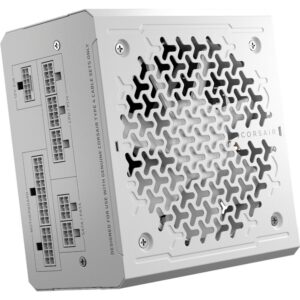
Corsair RM750e (2025) 750W Fully Modular Power Supply – White
Meets AMD’s 750W minimum for the RX 9070 XT.
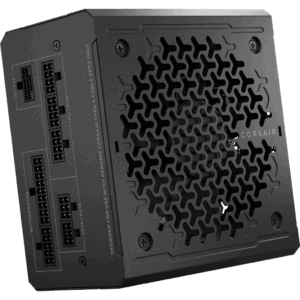
Corsair RM850e (2025) 850W Fully Modular Power Supply
Extra headroom for a high-end CPU and future upgrades.
Building from scratch? The AMD Ryzen 7 7800X3D is a popular gaming CPU to pair with either card. Keep it cool with our air cooler vs AIO guide.
FAQ
Is 16GB of VRAM enough?
Yes, for gaming at 1080p and 1440p. Both cards have 16GB, so memory isn’t the difference between them. The RX 9070 XT’s extra speed comes from its wider bus, extra cache and twice the compute units.
Will my power supply cope?
For the RX 9060 XT, a good-quality 450W unit with one 8-pin PCIe cable is the minimum. For the RX 9070 XT, you need 750W and two 8-pin PCIe cables. If your PSU is old or a no-name brand, replacing it is the safe option.
Do both cards support FSR 4?
Yes. AMD’s FSR 4 AI upscaling works on the whole RX 9000 series. It’s also coming to older cards and consoles, as we covered in our FSR 4.1 news story.
Our verdict
For most people gaming at 1080p, or who don’t want to replace their power supply, the RX 9060 XT 16GB is the sensible buy. It’s compact, easy to power and has plenty of memory. If you play at 1440p on a high-refresh monitor or fancy trying 4K, the RX 9070 XT is the one to save for. It’s around 75% faster at 1440p, and that’s a big enough gap to justify the extra spend and a 750W PSU. Check today’s prices and use the 1.75x rule to decide.
Planning a bigger upgrade? See our best RAM and storage upgrades guide, browse graphics cards and power supplies in our shop, or check today’s deals. If you can wait, our Black Friday 2026 UK guide explains what to expect.
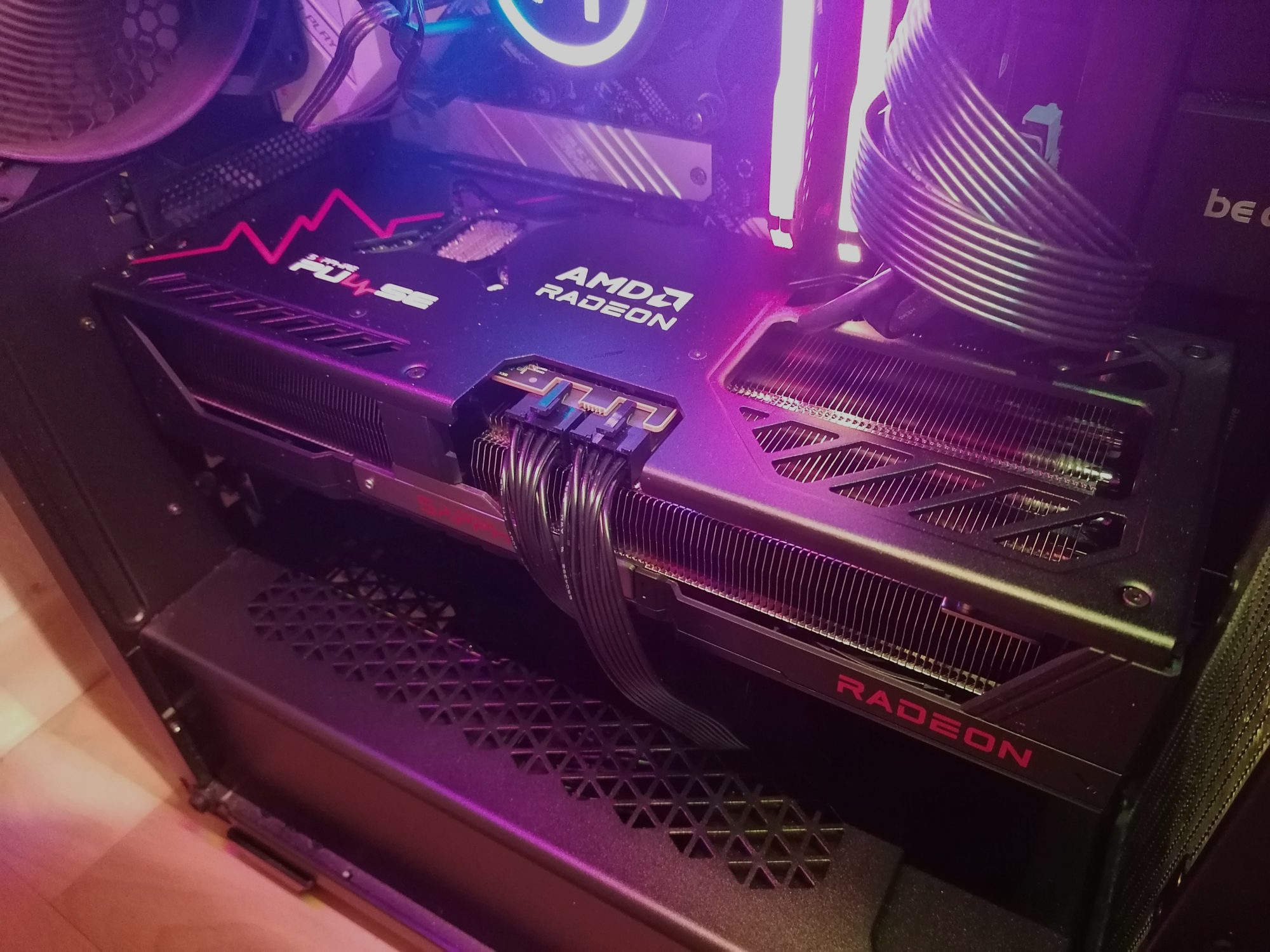
Featured image: Sapphire PULSE Radeon RX 9070 XT installed in a PC. Photo by Chaddy, via Wikimedia Commons, licensed CC BY-SA 4.0 (resized). Product images: manufacturer images from the official product listings.