As an Amazon Associate, TrueNorth Tech X earns from qualifying purchases. Read our affiliate disclosure.
Bought an RX 9070 XT, or about to, and wondering what PSU do I need for the RX 9070 XT? It’s a fair question, because a power supply that’s too small is the quickest way to random shutdowns and a lot of head-scratching. The good news is the answer’s fairly simple. AMD gives a clear minimum, and the main decision is whether to stop at 750W or go to 850W.
Quick answer
- AMD’s minimum is 750W for the RX 9070 XT, which has a typical board power of 304W.
- 750W is fine for a typical gaming build with a Ryzen 5 or Ryzen 7 such as the 7800X3D, at stock settings.
- Go 850W if you’ve a Ryzen 9 or Core i9, plan to overclock, or want headroom for a future upgrade.
- Check the plugs: AMD’s reference spec and the Sapphire PULSE use two 8-pin PCIe connectors.
Prices change often. Tap Check price on Amazon for today’s price.
| Product | Key spec | UK price at time of writing | Best for | Link |
|---|---|---|---|---|
| Corsair RM750e (2025) White | 750W, fully modular, ATX 3.1 | Check price | Ryzen 5 or 7 gaming builds at stock | View in our shop |
| Corsair RM850e (2025) | 850W, fully modular, ATX 3.1 | Check price | Ryzen 9 or Core i9, overclocking, headroom | View in our shop |
| Sapphire PULSE RX 9070 XT 16GB | 304W board power, 2 x 8-pin, 750W minimum | Check price | The card itself | View in our shop |
AMD’s official recommendation
AMD’s RX 9070 XT spec page lists a typical board power of 304W, a minimum PSU recommendation of 750W and two 8-pin power connectors. Sapphire says the same for its PULSE RX 9070 XT: 304W typical board power, a minimum 750W power supply and two 8-pin connectors. That’s the card we stock in the graphics cards section of our shop.
Bear in mind that the minimum is a whole-system figure. It assumes the rest of your PC is a normal gaming setup, not a power-hungry workstation.
750W or 850W? A simple way to decide
PSU makers publish their own sizing tables, and they’re a handy sanity check. Corsair’s recommended PSU table suggests 750W for an RX 9070 XT with a Core i5 or Ryzen 5, and 850W with a Core i7, Ryzen 7, Core i9 or Ryzen 9. MSI’s PSU table is a little more relaxed for gaming at stock, listing 750W with a Ryzen 7 or X3D chip and 850W with a Ryzen 9, but it suggests 850W with a Ryzen 7 if you overclock.
- Ryzen 5 or Core i5, stock settings: 750W.
- Ryzen 7 7800X3D or similar, stock settings: 750W meets AMD’s minimum and MSI’s gaming figure. Corsair’s table says 850W, so if the price gap is small, take the extra headroom.
- Ryzen 9 or Core i9: 850W.
- Overclocking, lots of drives and fans, or a bigger GPU later: 850W.
For reference, AMD rates the Ryzen 7 7800X3D at a 120W TDP, which is why it pairs comfortably with a 750W unit at stock. If you’re still deciding between cards, our RX 9060 XT vs RX 9070 XT comparison covers the cheaper option, which needs less power.
Cables and connectors checklist
- Two 8-pin PCIe plugs: the reference spec and the Sapphire PULSE need two. Use two separate PCIe cables from the PSU where you can, rather than one cable with a daisy-chained second plug.
- Some premium cards differ: certain partner models use three 8-pin plugs or a single 12V-2×6 connector, so check your exact card’s spec page before buying a PSU.
- No adapters from old Molex leads: if your current PSU hasn’t got the right PCIe cables, that’s a sign it’s time to replace it.
- Modular cables aren’t interchangeable: only use the cables that came with your PSU. Pin layouts differ between brands and even between ranges.
Corsair RM750e vs RM850e (2025)
The two power supplies in our power section come from the same range, so the differences are simple. Corsair’s RMe Series 2025 manual describes both as fully modular, ATX 3.1 and PCIe 5.1 compliant, with a native 12V-2×6 cable and Cybenetics Gold efficiency. The RM750e and RM850e each come with two 8-pin PCIe cables, plus a 12V-2×6 to dual 8-pin cable and two EPS CPU cables, so either has the plugs an RX 9070 XT needs.
Corsair RM750e (2025)
- Pro: meets AMD’s 750W minimum and has the cables you need
- Pro: usually the cheaper of the two
- Con: less headroom for a Ryzen 9, overclocking or a later GPU upgrade
Our shop listing is the white version, handy if you’re building an all-white PC. See it in our shop.
Corsair RM850e (2025)
- Pro: 100W of extra headroom for hungrier CPUs and upgrades
- Pro: same modular cables and connectors
- Con: costs a bit more, and overkill for a modest build
How to check your current PSU
Switch the PC off at the wall, open the side panel and look for the label on the power supply. It shows the brand, model and wattage. Search the model number to find its age and the PCIe cables it supports. If it’s under 750W, or it’s an old unit without two proper 8-pin PCIe cables, budget for a new one alongside the card. If you’re making other upgrades at the same time, our RAM and storage upgrades guide is worth a look too.
Verdict
For most RX 9070 XT gaming builds with a Ryzen 5 or Ryzen 7, a good-quality 750W unit like the RM750e does the job and meets AMD’s own minimum. If you’ve a Ryzen 9 or Core i9, like to overclock, or want room to grow, the RM850e is the safer buy and the extra cost is modest. Whatever you choose, make sure it has two proper 8-pin PCIe cables for the card. We haven’t tested these power supplies hands-on; the figures come from AMD, Sapphire, Corsair and MSI. See how we test and choose products.
FAQ
Is 750W enough for an RX 9070 XT?
Yes for most gaming builds. AMD lists 750W as the minimum PSU for the RX 9070 XT, and it suits a Ryzen 5 or Ryzen 7 system at stock settings. Go to 850W for a Ryzen 9 or Core i9, or if you overclock.
Is 650W enough for the RX 9070 XT?
AMD’s minimum recommendation is 750W, so we wouldn’t go below that. A 650W unit is better suited to cards like the RX 9070 or RX 9060 XT.
How many power connectors does the RX 9070 XT need?
AMD’s reference spec and the Sapphire PULSE RX 9070 XT use two 8-pin PCIe connectors. Some premium partner cards use three 8-pin plugs or a 12V-2×6 connector, so check your exact model.
How much power does the RX 9070 XT use?
AMD lists a typical board power of 304W for the RX 9070 XT.
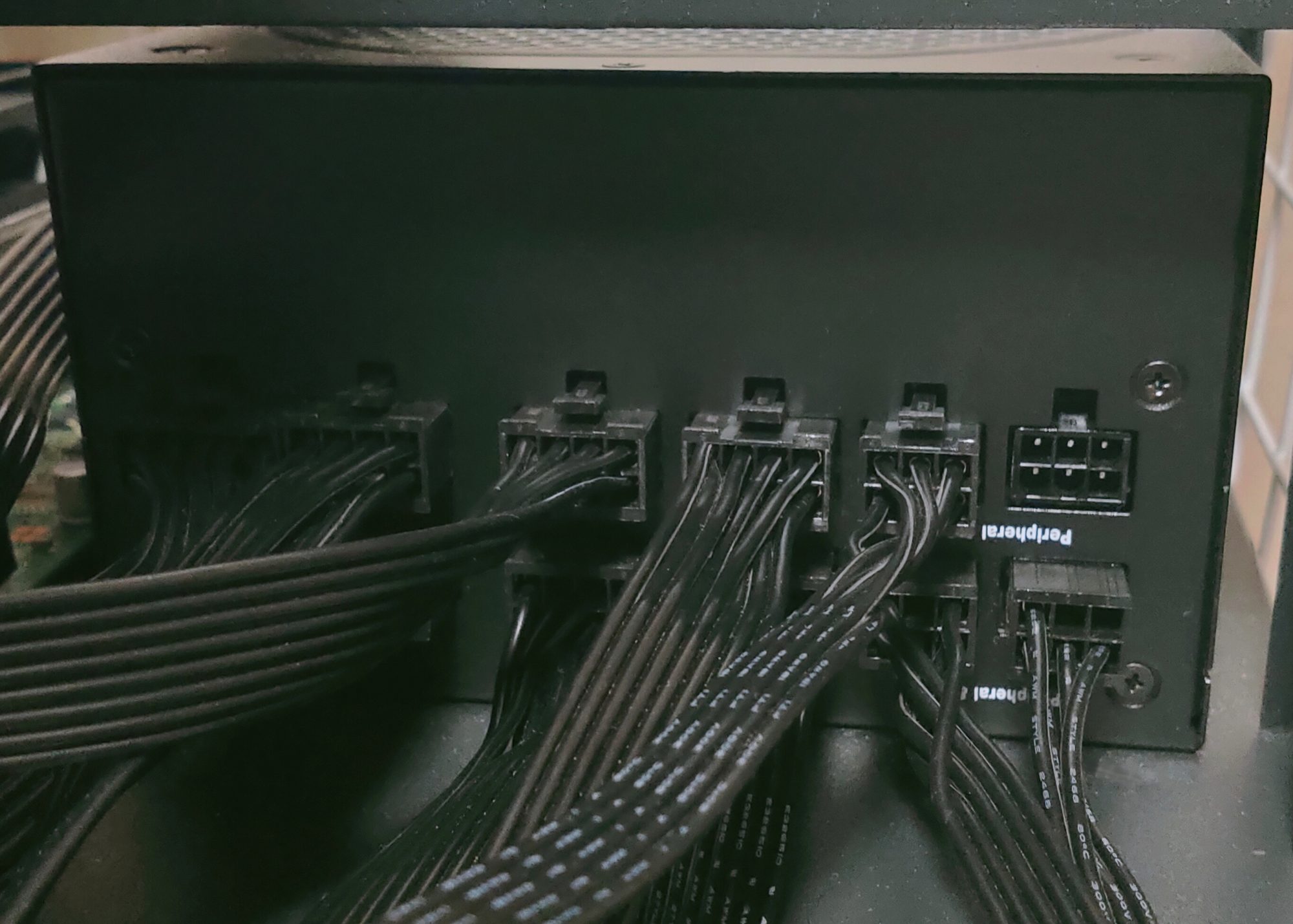
Featured image: Fully modular ATX power supply, photo by Project Kei via Wikimedia Commons, CC BY-SA 4.0.